If you have been following the AI space at all, you know it moves fast. In early 2026, we have more powerful AI models than ever — OpenAI's ChatGPT (GPT-5.2), Anthropic's Claude (Opus 4.6), Google's Gemini (3 Pro), and Elon Musk's Grok (4.1). Each one claims to be the best.
But "best" depends entirely on what you need it for.
At Digipahad, we use multiple AI models daily in our work — for writing, coding, research, client projects, and automation. Here is an honest, practical breakdown of what each model does well and where it falls short, so you can pick the right tool for the job.
ChatGPT (GPT-5.2) — The All-Rounder
ChatGPT is still the most widely used AI assistant in the world, and for good reason. OpenAI has consolidated its model lineup into GPT-5.2, which handles text, images, audio, and even video inputs in a single unified system.
Where it shines: General-purpose tasks, brainstorming, content drafting, STEM and math problems, and multimodal work (analyzing images, generating visuals). It also has the broadest ecosystem — plugins, custom GPTs, memory features, and integrations with thousands of apps.
Where it falls short: It can be verbose and sometimes overconfident in its answers. For deep coding tasks, other models have started to pull ahead. OpenAI recently introduced ads in its lower-tier plans, which may affect the experience for budget users.
Best for: Everyday business use, research, content creation, and anyone who wants one tool that does a bit of everything.
Pricing: Free tier available. ChatGPT Plus at $20/month. Pro at $200/month for heavy users.
Claude (Opus 4.6) — The Deep Thinker
Claude, built by Anthropic, has taken a different approach. Rather than trying to do everything, Claude focuses on doing fewer things exceptionally well — long-form reasoning, coding, document analysis, and structured writing.
Where it shines: Coding and software development (widely considered the best coding model right now), processing very long documents, thoughtful and nuanced writing, and safety-conscious responses. Claude's large context window lets it handle hundreds of pages in a single conversation. Its agentic coding tool, Claude Code, can autonomously work on multi-file engineering tasks.
Where it falls short: It does not have built-in image generation. Its plugin and integration ecosystem is smaller than ChatGPT's. It can sometimes be overly cautious in its responses.
Best for: Developers, writers, businesses handling large documents (legal, finance, research), and anyone who values depth and accuracy over breadth.
Pricing: Free tier available. Claude Pro at $20/month. Max plans up to $200/month.
Gemini (3 Pro) — The Google Native
Google's Gemini has matured significantly. Gemini 3 Pro ranks among the top models on intelligence benchmarks, and its tight integration with Google's ecosystem (Gmail, Docs, Search, YouTube) gives it a unique practical advantage.
Where it shines: Multimodal tasks (text, images, video, audio natively), integration with Google Workspace, very large context windows (up to 1 million tokens), and competitive pricing. Google's Gemini Flash models are extremely fast and cost-effective for high-volume use.
Where it falls short: Reliability in tool calling and complex multi-step tasks can be inconsistent. User preference scores sometimes lag behind ChatGPT and Claude, suggesting the raw intelligence does not always translate to the best user experience.
Best for: Teams already in the Google ecosystem, businesses needing fast and affordable AI at scale, and multimodal projects involving video or audio.
Pricing: Free tier available. Google AI Pro at $20/month.
Grok (4.1) — The Real-Time Rebel
Grok, built by Elon Musk's xAI, has carved out a niche as the AI that is plugged into live information. With direct access to X (formerly Twitter) data and real-time web search, Grok excels at staying current and delivering fast, personality-driven responses.
Where it shines: Real-time information and trending topics, massive context windows (up to 2 million tokens on SuperGrok), fast response times, and competitive pricing for its model tiers. Its conversational style feels more casual and direct.
Where it falls short: Coding accuracy lags behind Claude and ChatGPT. Academic benchmark scores are generally lower than the top competitors. Safety and content moderation have been controversial — multiple countries have investigated xAI over content generation issues.
Best for: Social media professionals, journalists, trend researchers, and users who need real-time data access and do not mind a less filtered AI personality.
Pricing: Free tier on X. SuperGrok at $30-$300/month depending on tier.
Quick Comparison at a Glance
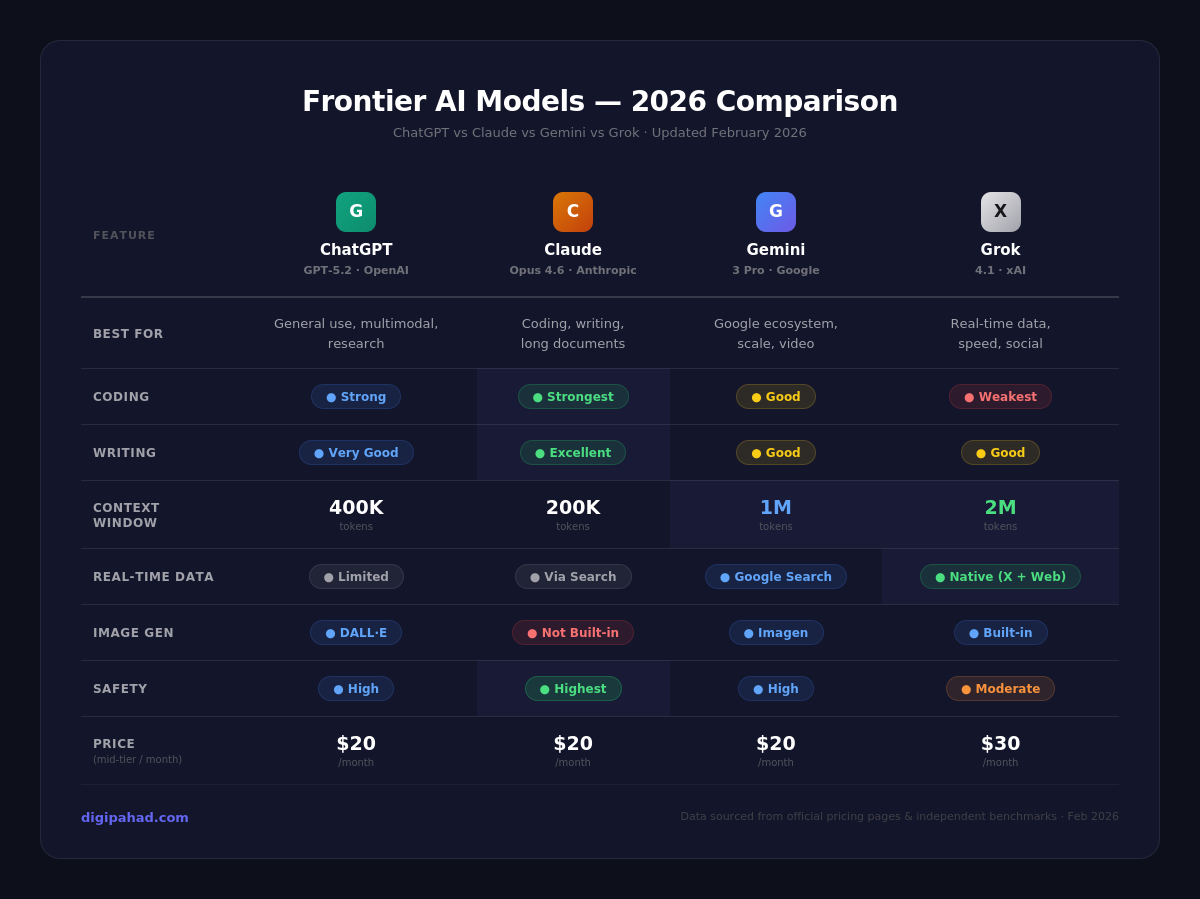
So Which One Should You Use?
The honest answer: use the one that fits your actual workflow.
If you are a business owner who needs one reliable AI for everyday tasks — ChatGPT is the safest bet. If you are building software or working with large documents — Claude is hard to beat. If your team runs on Google Workspace — Gemini integrates seamlessly. If you need real-time social and news intelligence — Grok delivers what others cannot.
Many professionals in 2026 use two or three of these tools depending on the task. There is no rule that says you have to pick just one.
What This Means for Nepali Businesses
AI is no longer optional for businesses that want to stay competitive. Whether you are using AI to draft proposals, automate customer communication, analyze data, or build software — choosing the right model (or combination of models) can save you hours every week and significantly improve output quality.
If you are not sure which AI tools fit your business, we are happy to help you figure that out.